 ▾
▾Digital nomadism is no longer the preserve of adventurers, but a phenomenon that is changing the job market and tourism industry. How has technology enabled working from anywhere in the world? What does it bring to companies and employees? And what challenges and downsides does this lifestyle carry?

Just ten years ago, it was a lifestyle few understood. Today, digital nomadism has become a phenomenon that redefines the labor market, changes the face of the travel industry, and inspires thousands of people to organize their lives according to their own rules. What led to digital nomadism, and what does it look like today?
Technological foundations of digital nomadism
The explosion of digital nomadism stems not only from a desire for freedom but also from rapid technological advancement. Without fast internet and cloud tools, this way of remote working simply wouldn't be possible.
Development of internet infrastructure
Fast and reliable internet connectivity is now available almost everywhere in the world. Satellite internet, the expansion of 5G networks, and public Wi-Fi in cafes, libraries, and coworking spaces allow digital nomads to stay connected virtually from anywhere.
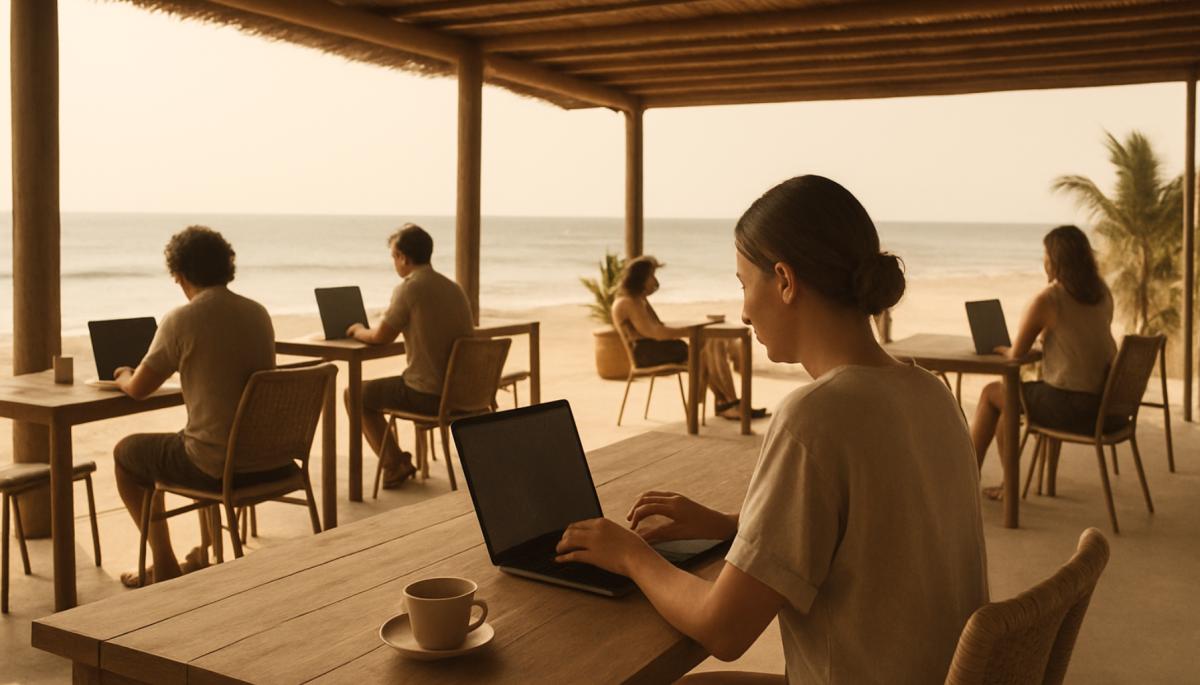
Thanks to these advances, they can work from mountain cabins, beaches, or remote villages without losing contact with their clients or employers. There are even nomads who travel in caravans or boats, using satellite internet for work.
Cloud technology and collaborative tools
The shift to cloud solutions has removed the need for physical access to files and company systems. Tools like Google Workspace, Microsoft 365, or Dropbox allow document sharing and real-time collaboration regardless of physical distance.
Also indispensable are tools like Notion, Asana, Trello, or Monday.com, which ensure efficient project management across continents and time zones.
Interesting solutions include apps like Slack or Discord, which create virtual office environments where teams can communicate with each other. There are also video conferencing tools such as Zoom, Microsoft Teams, or Google Meet.
Development of financial technology
Also significant is the development of digital banking, cryptocurrencies, and payment platforms like Wise or Revolut, which allow digital nomads to manage their finances globally. Thanks to them, they can receive payments in different currencies, minimize transfer fees, and effectively manage their finances regardless of their current location.
What does nomadism mean for companies and employees?
The phenomenon of digital nomadism significantly changes the job market. However, it also brings new opportunities and challenges for employers and employees.
Benefits for employers
Digital nomads are not just freelancers. Increasingly, they are specialists working for international firms that rely on remote collaboration.
This can benefit both sides:
- Companies gain global talents without the need for relocation. They save on office operating costs, increase productivity, and address new challenges in managing international teams.
- Employees appreciate the freedom, better work-life balance, and the chance to develop across cultures and time zones.
Challenges for employers
Digital nomadism is, of course, not without its pitfalls—from a company perspective. The legal and tax jungle encountered when employing people across continents often requires the help of specialized agencies. Each country has its own rules, and ignorance can be costly.
Another big challenge is managing teams spread across the world. Traditional meetings at 2 pm? Morning for some, deep night for others. Communication often needs to be asynchronous, respecting cultural differences and setting clear processes.
The issue is corporate culture, which is much harder to build remotely. Virtual teambuildings, shared online breakfasts, or strategic offline meetings become a necessity, not a bonus. Without them, there's a risk of the team becoming just a cluster of names on a screen.
Changes for employees
For employees, digital nomadism is a dream come true. The ability to pack a laptop and work from a place that suits them—whether it's a city apartment, a mountain chalet, or a seaside village—brings invaluable flexibility. Many spend more time with family or choose places with lower living costs and higher quality of life.
Work-life balance also improves. There's no more unnecessary commuting, and they can work at their peak productivity times according to their biological rhythm.
Digital nomadism also develops them on a personal level. Every new country, language, or culture brings fresh inspiration, challenges, and skills that can't be learned in an office. The result is greater creativity, openness, and often a deeper sense of purpose in their work.

Downsides of digital nomadism
Although digital nomadism may seem like an ideal lifestyle at first glance, it is not without its challenges. Constant travel can lead to burnout and loneliness—especially if a stable community or relationships are missing. Mental fatigue from constantly adapting to new environments is more common than admitted.
The biggest problem presents itself with unclear tax residency—meaning, the question of which country the nomad should pay taxes to, if they move between several states throughout the year. Without a clearly defined place of residence, there's a risk of double taxation, where multiple countries claim tax from the same income.
Another issue is invoicing foreign clients, which in some countries may require taxation even without permanent residence. Often there's an underestimation of social and health insurance, especially if the nomad doesn't formally register with any system.
Even establishing companies in 'friendlier' countries doesn't always solve the situation—if it becomes apparent that business activities occur elsewhere, the country may demand its contributions.
How digital nomads are changing the face of tourism
Digital nomadism is reshaping traditional travel models and creating new opportunities and challenges for tourism industries worldwide.
Long-term stays and slow travel
While traditional tourists visit destinations for days or weeks, digital nomads often stay for months. This 'slow travel' trend brings more stable income for local economies and reduces the ecological footprint associated with frequent moves.
Digital nomads tend to integrate more into local communities, learn the local language, and get to know the culture more deeply. This leads to more authentic experiences and positive interactions with locals.
Transformation of tourist destinations
Traditional tourist destinations adapt to the needs of digital nomads. Hotels and accommodation facilities offer long-term stays with discounts, workation packages, and workspaces. Specialized places are emerging that combine accommodation with workspaces and community activities.
Places previously overlooked by tourists are coming to the forefront—Tbilisi, Medellín, Chiang Mai. Cities with a unique atmosphere, affordable prices, and a welcoming approach to digital workers are experiencing a new economic wave. Entire regions are therefore investing in improving internet infrastructure to attract digital nomads.

Where are digital nomads heading in 2025?
Digital nomadism is no longer just about Thai beaches and Berlin cafes. The year 2025 brings new destinations, modern visa programs, and the emergence of entire communities tailored to life on the go. So where are the nomads of the coming years heading?
Popular destinations for digital nomads
Among the most sought-after destinations for digital nomads in 2025 is undoubtedly Portugal. Lisbon and Madeira lead the European charts thanks to their pleasant climate, high quality of life, and friendly digital infrastructure. The combination of affordable costs and a vibrant atmosphere makes them ideal places for freelancers and remote employees alike.
Across the Atlantic, Mexico is seeing significant growth. Its benefits include a time zone compatible with U.S. working hours, as well as rich culture and favorable living costs. Cities like Mexico City, Mérida, and Playa del Carmen today host ever-growing communities of digital workers, offering them the perfect environment for work and life.
More nomads are also heading to Georgia. With a simple visa policy allowing a one-year stay without unnecessary administration, it is becoming an increasingly attractive choice. Tbilisi offers a unique mix of European and Asian culture, great food, and low living costs.
The classic favorite, Thailand, never loses its popularity. From bustling Bangkok to quieter Chiang Mai and tropical islands like Ko Lanta or Ko Phangan, the nomadic community here is strong and well established.
Special visas for digital nomads
The European counterpart to the exotic is Estonia. Thanks to its e-residency program, entrepreneurs from anywhere in the world can set up a business, handle accounting, or communicate with authorities — all fully online.
Estonia confirms its position as a digital hub of Europe and demonstrates what the future of administration and business might look like. Other countries offering special visas for digital nomads include Barbados and Croatia.
Villages for remote work
A recent trend is nomadic villages — fully equipped places where living, work, and community life converge. Projects like Nomad Village Madeira or Digital Nomad Valley Zadar offer not only coworking and fast internet but also wellness programs, events, and social life.
For many, it's the ideal entry point into nomadic life — without the feeling of loneliness, and with the opportunity to build friendships and professional relationships.
Digital nomadism is proof that work doesn't have to be a place we go to. It can be anything — a boat, a café, or a mountain cabin. And most importantly, it can be a way to live life on your own terms.
Phone instead of a card or key. What is NFC and how does it work?

Just hold your phone up to a terminal and within moments the payment is made. However, NFC technology is capable of much more. We will explain what NFC is and how it works, what actually happens during NFC mobile payments, what else you can use it for, and how secure it is. We will also show what NFC tags are and how they can simplify some daily tasks.
What would happen if the internet went down for a day?

What if there was a full-day internet outage? An immediate collapse of society wouldn't occur, but daily operations would quickly become complicated because today's world is more dependent on the internet than we often realize. Which services would stop functioning first, and what would happen with payments, transportation, or work?
WPA, WPA2, WPA3: Which Wi-Fi security should you use today?

WPA, WPA2, WPA3, AES or TKIP? Wi-Fi security settings might initially seem unnecessarily complicated. However, when you understand what each abbreviation stands for, it becomes fairly simple. Therefore, we'll explain the differences between them and which is the best choice today. We'll also suggest what settings to choose if you have older devices at home that don't support the latest standard.
Is incognito mode really anonymous? Who still sees what you're doing

Do you think incognito mode hides you from everyone on the internet? In reality, it works a bit differently. We explain what it actually does, when it's sensible to use it, who can still see your activity, and whether history can be traced in incognito mode.
Why Does AI Hallucinate? A Peek Under the Hood of Language Models

AI can answer almost any question in just a few seconds. However, sometimes it confidently states information that is not true. Why does this happen and what are so-called AI hallucinations? In this article, we'll explain how large language models work, why they sometimes create false answers and how developers are gradually trying to mitigate this issue.
What is a CDN and why is internet content copied worldwide

Behind every loaded video, photo, or webpage is a technology called CDN. It is used by streaming services, social networks, and regular websites, yet many people have never heard of it. In this article, we will explain what this abbreviation means, how it works, why internet content is stored in various locations around the world, and why today's internet can hardly do without it.