 ▾
▾When talking about inheritance, most people think of a house, a car or money in the account. Yet we also leave behind thousands of photos, emails, social media accounts or data stored in the cloud. What happens to them after death, and who will gain access to them? This article looks at how digital legacy works, why the bereaved may have problems with data, and how to get organized in your online footprint today.

Photos in the cloud, years of email communication, social media accounts, streaming service subscriptions, or access to online banking. Most of us accumulate a vast amount of data over the years that exists solely in digital form.
While many people ponder the fate of physical property after death, online accounts and digital data are often overlooked.
Who will gain access to stored photos or important documents? And can the bereaved decide this, or do tech companies have the final say?
What we leave behind on the internet
Digital legacy includes everything we leave behind in the online environment. It's not just about content we consciously share on the internet. It also includes data stored on various service servers, login accounts, or digital content acquired during our lives.
Examples of digital legacy may include:
- email boxes,
- photos and videos stored in the cloud,
- social media accounts,
- communication in apps like WhatsApp or Messenger,
- online banking,
- investment accounts,
- cryptocurrency wallets,
- online subscriptions,
- digital books, films, or music.
The scope of this data can be surprising. Whereas people used to leave behind mostly letters, photo albums, or documents stored in drawers, today they may possess thousands of photos, dozens of online accounts, and years of communication stored in various services.
Some of this data has primarily sentimental value. Others may contain information essential for property management or the regular functioning of a family.
What happens to your accounts after death?
Many people assume that an inactive account will eventually disappear after death. However, in reality, it can continue to exist for many years. It depends on the specific service's rules and whether anyone takes steps to have it removed.
This is why major tech companies have begun creating tools for managing digital legacies. Facebook allows accounts to be memorialized or to designate someone who can manage it with limited options. Google offers inactive account management, allowing users to pre-set what should happen with data after a period of inactivity. Apple provides a similar option.
These tools allow users to determine how their accounts or data will be handled after their death. Each platform approaches the entire issue differently, and the rules can vary significantly.
Who has access to your data after death
Just because an account doesn't vanish doesn't mean anyone will access it.
Access issues for the bereaved often include:
- unknown passwords,
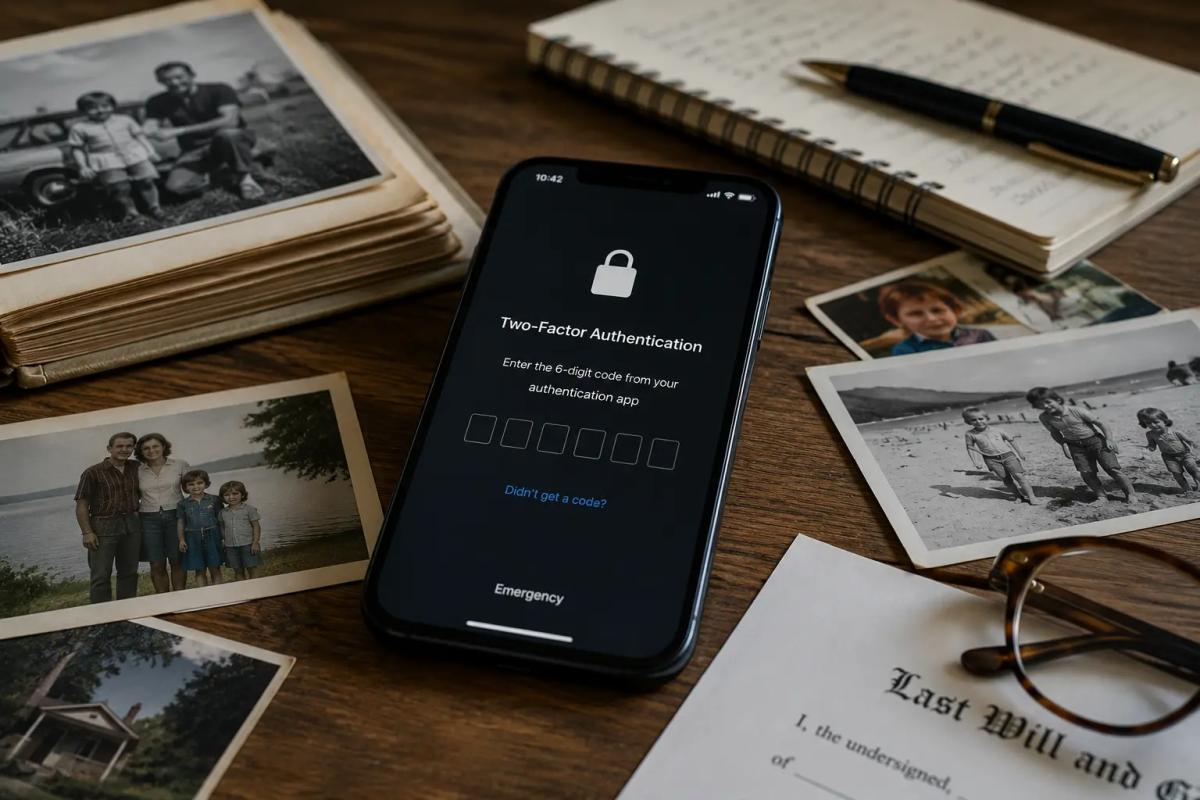
- two-factor authentication,
- lost or locked devices,
- specific service rules,
- lack of post-death account management settings.
Thus, a family may know there are photos, documents, or important information somewhere, but they can't access them. For some services, it's not enough even if you're immediate family.
The situation is further complicated by the difference between data ownership and access. Photos or documents may be yours, but access rules are determined by the service hosting them. That's why digital legacy often falls into a gray area between technology, privacy, and family expectations.
Similar rules apply to digital content paid for during one's lifetime. In the case of electronic books, films, or music, we often don't own the content but only a license to use it. This is usually tied to a specific user and may not automatically transfer to others upon their death.
How to organize your digital legacy today
Thinking about such situations isn't pleasant. However, a few simple steps can save your loved ones a lot of trouble.
Create an overview of your accounts
An overview of the services you use is among the most practical things you can prepare in advance. It doesn't have to include passwords or sensitive data. A simple list of important accounts can significantly help the bereaved navigate.
Consider including services you don't use every day when compiling it. In addition to social media, payment services, cloud storage, online marketplaces, investment platforms, or cryptocurrency wallets may also be important. These accounts are often forgotten.
Set up trusted contacts
If you use Google, Apple, or Facebook, it’s worthwhile to check the account management settings for prolonged inactivity or death. These features allow you to pre-determine who will have access to your selected data after your death or who will be able to manage the account.
Setting this usually takes only a few minutes and can significantly simplify access to important information when you can no longer decide.
Consider a digital will
Just as people handle dividing physical property, they can also consider the fate of their digital life. Some might want their accounts to remain as a family memory. Others may prefer to have them removed.
A digital will doesn't have to be complicated. What's important is documenting your wishes and determining how your accounts and data should be handled.
Not everyone wants their digital footprint preserved. Some people prefer their profiles, files, or additional data to be removed after death. Reasons could include privacy protection, security, or simply not wanting to leave behind too much digital clutter.
Discuss it with your family
Even a well-prepared account list may not be enough if no one knows about it. Thus, it's meaningful to inform your loved ones that such information exists and where they can find it if necessary.
These conversations might not be pleasant, but they can prevent many misunderstandings. The clearer your loved ones understand your wishes, the easier it will be for them to navigate the situation.
Clearly expressed wishes can also help when family members have differing opinions on the fate of accounts or data. While one may want everything preserved as a memory, another might prefer deletion. Knowing the wishes beforehand can make decisions easier.
You may never completely disappear from the internet
A few years ago, digital legacy mainly involved accounts, photos, or stored documents. However, with the rise of artificial intelligence, the whole topic has taken on a new dimension.
Today, there are services capable of creating digital likenesses of deceased individuals based on messages, emails, photos, or social media posts. They can mimic the communication style or respond in a manner reminiscent of a real person.
These technologies allow a person's digital footprint not just to be a memory archive but to interact with living people actively.
For some, this is an intriguing way to preserve memories. Others consider this use of data ethically contentious. The only certainty is that the question of digital legacy has long since been about more than just passwords and account access.
Frequently Asked Questions
Can the bereaved request the deletion of a deceased person's account?
In most cases, yes. The exact procedure varies by service. Some platforms require a death certificate or other proof confirming the user's death.
What if no one knows the password or access email?
Options are usually limited. Some services offer a special process for bereaved individuals, while accessing others may be very challenging or impossible.
Can cryptocurrencies be inherited?
Yes, but only if there is a way to access the private keys or login details. Without these, cryptocurrencies may be irretrievably lost.
Can a social media account be transferred to another person?
Generally not. Some services allow post-death account management or memorialization, but full account transfer to another person is rare.
Do I need to give my family all my passwords?
No. It's safer to create an overview of important accounts, set up trusted contacts where possible, and clearly describe where to find necessary access when needed.
Phone instead of a card or key. What is NFC and how does it work?

Just hold your phone up to a terminal and within moments the payment is made. However, NFC technology is capable of much more. We will explain what NFC is and how it works, what actually happens during NFC mobile payments, what else you can use it for, and how secure it is. We will also show what NFC tags are and how they can simplify some daily tasks.
What would happen if the internet went down for a day?

What if there was a full-day internet outage? An immediate collapse of society wouldn't occur, but daily operations would quickly become complicated because today's world is more dependent on the internet than we often realize. Which services would stop functioning first, and what would happen with payments, transportation, or work?
WPA, WPA2, WPA3: Which Wi-Fi security should you use today?

WPA, WPA2, WPA3, AES or TKIP? Wi-Fi security settings might initially seem unnecessarily complicated. However, when you understand what each abbreviation stands for, it becomes fairly simple. Therefore, we'll explain the differences between them and which is the best choice today. We'll also suggest what settings to choose if you have older devices at home that don't support the latest standard.
Is incognito mode really anonymous? Who still sees what you're doing

Do you think incognito mode hides you from everyone on the internet? In reality, it works a bit differently. We explain what it actually does, when it's sensible to use it, who can still see your activity, and whether history can be traced in incognito mode.
Why Does AI Hallucinate? A Peek Under the Hood of Language Models

AI can answer almost any question in just a few seconds. However, sometimes it confidently states information that is not true. Why does this happen and what are so-called AI hallucinations? In this article, we'll explain how large language models work, why they sometimes create false answers and how developers are gradually trying to mitigate this issue.
What is a CDN and why is internet content copied worldwide

Behind every loaded video, photo, or webpage is a technology called CDN. It is used by streaming services, social networks, and regular websites, yet many people have never heard of it. In this article, we will explain what this abbreviation means, how it works, why internet content is stored in various locations around the world, and why today's internet can hardly do without it.