 ▾
▾Fast and stable connection is a basic necessity in every household today. The solution is fiber optic internet, which works differently than regular cables and offers greater reliability to users. We'll explain how this technology works in practice, what it entails to run a fiber optic cable to your home, and what equipment you’ll need to keep everything running smoothly.

The internet in households has come a long way in the past few decades. In the 1990s, we connected to the network via dial-up lines, which blocked the phone and could only transfer a small amount of data. Over time, ADSL and other forms of connection over copper cables arrived, offering higher speeds but still encountering their limitations. Anyone who has experienced evening connection fluctuations or slow video uploading knows that older technologies have their weaknesses.
In response to the growing demands of households, fiber optic internet began to play a key role. It has become synonymous with stable connection and high speed, which regular cables cannot offer. Thanks to these characteristics, it becomes the most reliable way to have a connection at home that can be relied upon even under heavy load.
Today, optics represent the technology that sets the direction of internet development. If you're curious why it’s considered a step forward compared to traditional connection methods, let's take a closer look.
What is fiber optic internet?
Fiber optic internet is a type of connection that, instead of traditional copper cables, uses thin glass fibers. These do not transmit an electrical signal but light. Thanks to this, optics can transmit a vast amount of data over long distances without noticeable attenuation or interference. The result is a fast and stable connection that works reliably even under heavy load.
Unlike older technologies such as DSL or cable connections, the fiber optic network is not as susceptible to external influences. It is not afraid of moisture or surges during storms, making outages very rare. This is why optics have become the standard in backbone networks that connect entire countries and continents.
In households, metallic cables long dominated because they were easier to build. However, with the rising demand for speed and stability, optics have begun to reach more frequently into apartments and family homes. Today, it is among the most reliable solutions if you're looking for internet that can handle work, entertainment, and smart home operations.
How does fiber optic internet work in practice?
In practice, much depends on how far the fiber optic cable is extended. If it ends directly in your household, you get a stable connection with the lowest latency. But if the cable ends earlier and the last part is resolved with different wiring, the quality may not be perfect.
Depending on where it terminates, various types of fiber optic connection are distinguished:
- FTTN (Fiber To The Node) – the cable ends at a node several kilometers away, and the rest of the journey uses another cable.
- FTTC (Fiber To The Curb/Cabinet) – the cable is extended to a distributor near the house, and the last section to the household uses different wiring.
- FTTB (Fiber To The Building) – the cable ends in a building, and older cabling leads to individual apartments.
- FTTH (Fiber To The Home) – the best option where the cable goes directly into the household.
For the connection to work correctly, suitable end equipment is needed. Most commonly, it is a router for the fiber optic cable, which connects to the optical outlet and distributes the internet throughout the household, either via cables or using Wi-Fi. In some cases, there's an optical network terminal (ONT) between the outlet and the router, which works similarly to a modem for fiber optic internet. It converts the light signal from the fiber into a data signal that the router can work with.
Thanks to this, you get a connection with low latency, high stability, and the ability to handle situations where multiple devices are connected to the network simultaneously.
Installation of fiber optic cable into a house or apartment
If you've understood what fiber optic internet is, you are probably interested in the installation itself. The first step is to verify availability. The provider will determine based on your address whether a fiber optic network already runs in the area and what connection options are available.
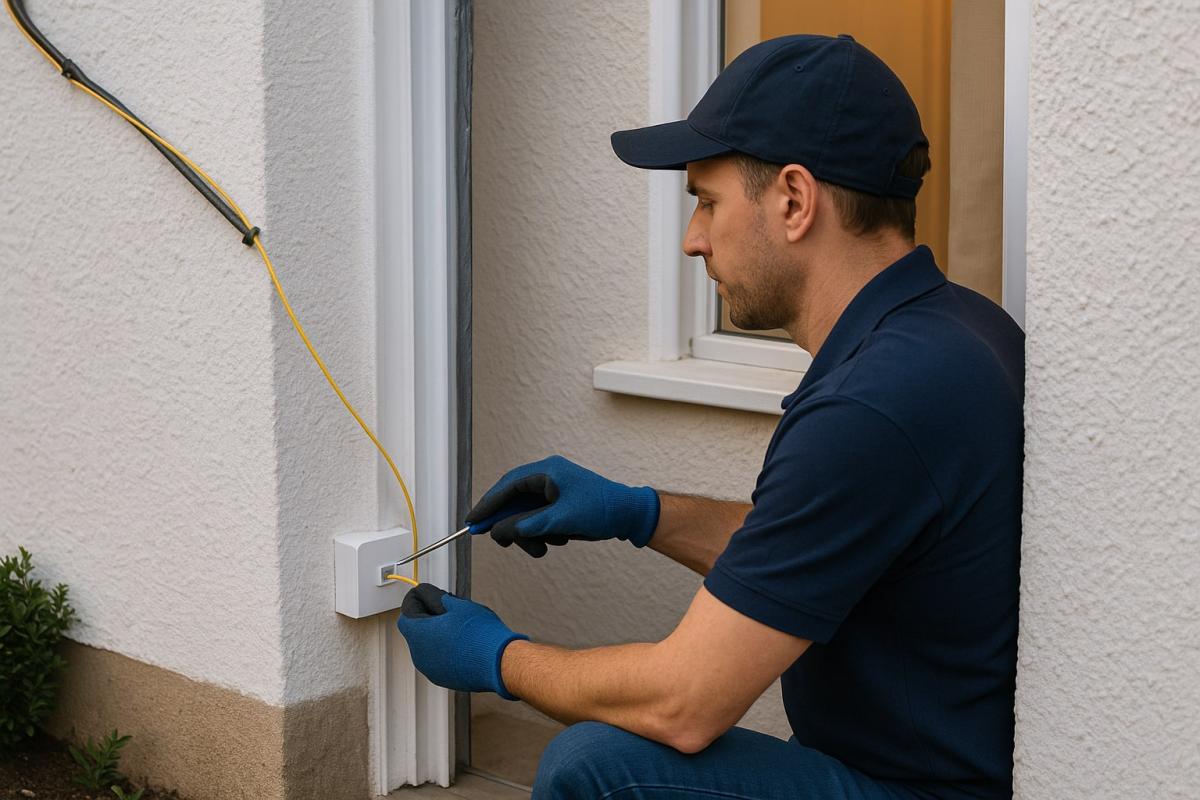
If optics are available, technicians bring a cable from the street or common areas in an apartment building to the household. It ends with a small optical outlet, most often installed in the living room or study.
This outlet then connects to a router for the fiber optic cable, which distributes the internet throughout the home via cables and Wi-Fi.
The installation itself usually takes only a few hours. For family homes, it may involve drilling through a wall and routing the cable from outside to inside. In apartment buildings, risers or common spaces are mostly used, so the intervention is generally smaller.
The installation conditions vary depending on the provider. Basic installation might be free of charge in some places, while others may require a small fee. If more complex construction work is needed, the cost is higher, but it depends on the specific situation.
How to choose the right provider?
Choosing the right provider is key to getting the most out of fiber optic internet. It's not enough to look at just the price or the stated speed. It's important to know what real connection quality you can expect at your address. Therefore, it's worth checking not only availability but also the experiences of other users in the area.
Ask whether the connection remains stable even during peak times when the network is most loaded, and what the average latency values are. Technical support also plays a role. A reliable provider should respond quickly to potential problems and offer clear service conditions.
Consider the future needs of the household. The fiber optic network has the potential to handle much more than we use today, from high-definition streaming to online learning and remote work, to running smart devices. A provider investing in the development of its infrastructure will ensure you're prepared for new services that will come in the future years.
The future of connection is optical
The development of internet infrastructure is heading towards optics becoming a common part of every household. While it used to be the privilege of big cities or new builds, it is gradually being built in smaller areas. Transitioning from older technologies is an investment in long-term reliability. One of the greatest advantages is that the optical fiber has virtually unlimited capacity and can transmit data in the range of tens of gigabits per second.
In the future, it's expected that having a fiber optic cable installed in your home will be as standard as electricity or water supply. Such a solution ensures stability, resistance to external influences, and preparedness for services that will require even higher speeds than today. If you're looking for long-term reliable connectivity, optics is a technology you can rely on for years to come.
Phone instead of a card or key. What is NFC and how does it work?

Just hold your phone up to a terminal and within moments the payment is made. However, NFC technology is capable of much more. We will explain what NFC is and how it works, what actually happens during NFC mobile payments, what else you can use it for, and how secure it is. We will also show what NFC tags are and how they can simplify some daily tasks.
What would happen if the internet went down for a day?

What if there was a full-day internet outage? An immediate collapse of society wouldn't occur, but daily operations would quickly become complicated because today's world is more dependent on the internet than we often realize. Which services would stop functioning first, and what would happen with payments, transportation, or work?
WPA, WPA2, WPA3: Which Wi-Fi security should you use today?
WPA, WPA2, WPA3, AES or TKIP? Wi-Fi security settings might initially seem unnecessarily complicated. However, when you understand what each abbreviation stands for, it becomes fairly simple. Therefore, we'll explain the differences between them and which is the best choice today. We'll also suggest what settings to choose if you have older devices at home that don't support the latest standard.
Is incognito mode really anonymous? Who still sees what you're doing

Do you think incognito mode hides you from everyone on the internet? In reality, it works a bit differently. We explain what it actually does, when it's sensible to use it, who can still see your activity, and whether history can be traced in incognito mode.
Why Does AI Hallucinate? A Peek Under the Hood of Language Models

AI can answer almost any question in just a few seconds. However, sometimes it confidently states information that is not true. Why does this happen and what are so-called AI hallucinations? In this article, we'll explain how large language models work, why they sometimes create false answers and how developers are gradually trying to mitigate this issue.
What is a CDN and why is internet content copied worldwide

Behind every loaded video, photo, or webpage is a technology called CDN. It is used by streaming services, social networks, and regular websites, yet many people have never heard of it. In this article, we will explain what this abbreviation means, how it works, why internet content is stored in various locations around the world, and why today's internet can hardly do without it.